General Information
Why Emus?
Breeding
Chicks
Care of Young Emu Chicks
Eggs
Feeding
Fencing
Health
Housing
Licence
Incubation
General Info
-top-
Are native to Australia
May live up to 30 years
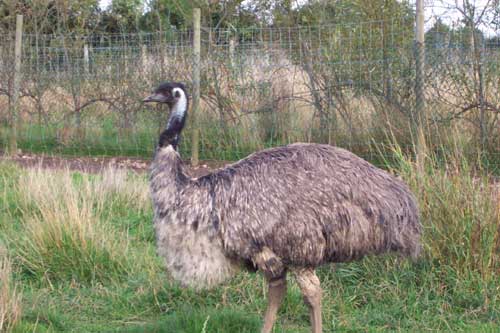
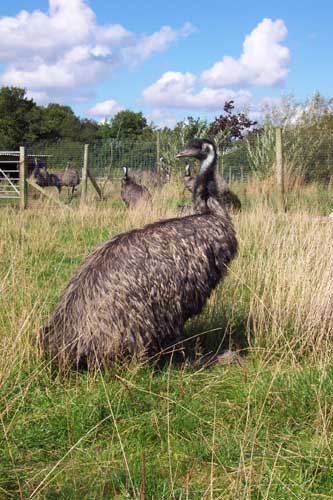
Are between 4' and 6'6" tall
Weigh between 80 and 120lbs
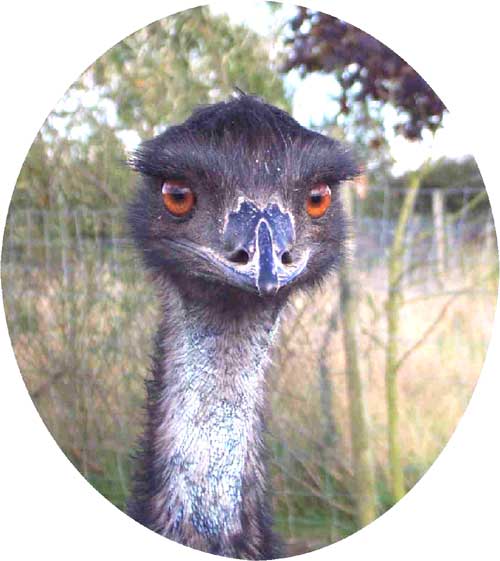
Are very inquisitive
Are not aggressive
Mature at 2 years
Lay 30 - 40 dark green eggs in the winter
Incubate for about 56 days
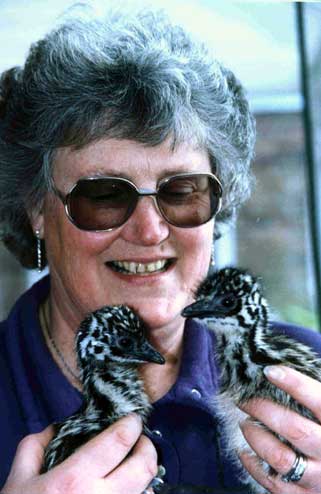
Chicks are about 7" when they hatch
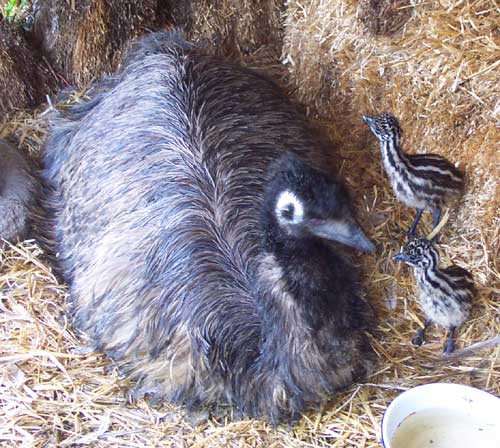
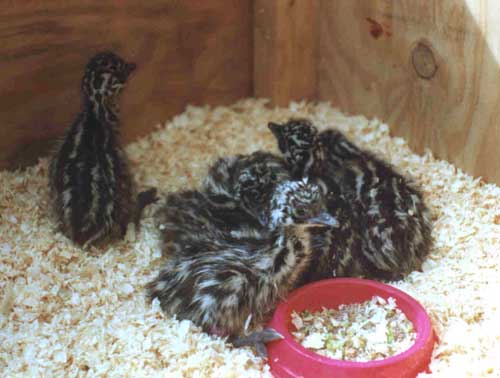
Chicks are striped with speckled heads
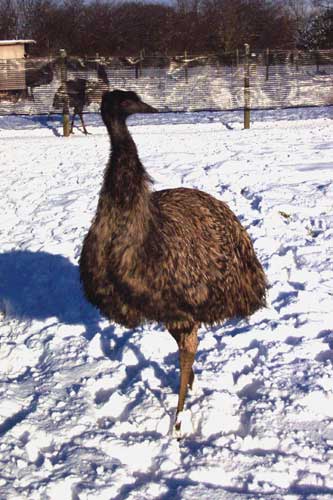
Are very hardy in all weathers
Ideal for farming in the UK
Products: Meat, eggs, feathers, oil and leather
Emus (native to Australia) belong to the Ratite family, as
do ostriches (native to Africa), rheas (native to South America),
cassowaries (native to Australia) and kiwis (native to New
Zealand). Emus may be kept for pleasure or farming. They are
now farmed in many countries worldwide - New Zealand, Canada,
USA, Mexico, Japan, Belgium, France, Scandinavia, UK and others.
Domestic farming of emus is relatively new, about 12 years
in America and more recently in the UK. Ostriches have been
the forerunner in the farming of ratites but emus are smaller,
hardier, not aggressive and easier to rear successfully from
chicks. Emus are very inquisitive; they are also quite nervous
and can therefore easily be frightened by sudden movements
or noise. They are generally docile birds and not naturally
aggressive. They soon get to know who feeds and cares for
them and they quickly learn the daily routine. They are hardy
in our variable British weather, often choosing to sit out
in rain or snow rather than go inside. They don't like days
with strong, cold winds and rain. Like most of us, they enjoy
the sunshine. On a warm sunny day, they potter happily around
their pen eating, drinking or sunbathing. Emus do not need
a lot of space; although the more space they have the less
likely you are to have squabbling at breeding time. Remember,
like all living things, emus are individuals. They vary in
their behaviour, appearance and performance.
Why Emus? -top-
Adult Size: 5' - 6'6" tall
Health: Robust and hardy
Adult Weight: Approx 100lbs
Temperament: Friendly, docile, inquisitive
Lifespan: Approx 30 years
Productive Life: 25years.
Eggs: 30 - 40 per year.
Successful Hatch: 70% - 80%
Emus have the potential to become very successfully
farmed in this country. They do not require fertile or good
quality ground. They are a 'totally useable bird': meat, eggs,
leather, feathers and oil. They are already increasingly and
successfully being farmed in America, Canada, Australia, New
Zealand, Japan, Mexico, Middle East, Africa and parts of Europe
and Scandinavia. If you have experience of rearing poultry,
then emus are no more difficult. Their needs are very similar
to that of chickens although adult management requires much
more space. Breeding pairs may be kept in separate pens or
a larger number can be kept as a colony, it depends on the
area of land available and personal preference. Emu are a
source of excellent meat, fine leather, eggs and eggshells,
feathers and oil. Meat. The meat is a red meat, very similar
to beef in appearance and taste. It has the healthy attributes
that will attract anyone who is conscious of the quality of
their diet. It is very low in fat and cholesterol but high
in protein. It is therefore very high quality meat. The meat
is from the rump and the drumstick, there is no breast meat.
A large proportion is suitable for use as steak for frying,
grilling and of course is ideal for the bar-b-que - high temperature,
quick cooking! Some joints are suitable for roasting and others
for casseroles. It can be made into burgers and sausages.
The emu has the greatest food to muscle conversion rate in
the first year. It is generally ready for slaughter at 14
- 16 months old. This is therefore the most economic age to
use for meat. A quality bird should produce about 32 -36lbs
of meat at this age.
I have been successfully selling meat into
local restaurants, direct to the public through Farmer's Markets
and from the farm gate. Leather. The skin produces a very
fine quality leather that is used for luxury goods. The skins
vary in size, about 8 - 10 sq ft per bird. Major tanning companies
require large numbers of skins, but there may be a smaller
company near you who would accept smaller numbers. Oil. The
oil has of course been used for centuries by the aborigines
for cosmetic and medical purposes. There is now, in other
countries, considerable research into the oil for its cosmetic
and pharmaceutical uses. The fat can be processed to produce
an oil that is unsaturated and non toxic. It also has properties
that enable it to absorb other substances very easily and
to penetrate the skin quickly. Feathers. Craft and fashion
applications. They also have anti-static properties, which
must have some commercial applications! Eggs. If incubation
facilities are available, it is most cost effective to hatch
the emu chicks. They lay between November to May and incubation
varies from 50 - 60 days. Hatching will be from January to
June. The young chicks will therefore need to be kept on heat
for varying lengths of time. I offer an incubation service
for emu, rhea and ostrich eggs. Eggshells are much in demand
by craft 'egg decorators'.
The eggshells are formed in 3 layers,
the outer layer is very dark green (like an avocado), the
middle layer is a pale blue/green and the inner layer is white,
so pictures can be etched or carved into the surface, as well
as the Faberge style decoration. Breeding emus in this country
is a very new industry. Consequently there are no ready set
up channels for marketing your products although there are
an increasing number of enthusiastic emu breeders who are
working towards setting up such outlets. At present the birds
can be slaughtered on site, so local hotels or restaurants
are an excellent outlet for such a high quality meat. The
number of processing plants, allowing the sale of the meat
throughout the UK, is slowly increasing.
Breeding
-top-
Emus are not sexually mature until 2 years
old. They usually pair up during their second Autumn, ready
for mating and egg laying during their second Winter. Emus
pair for life. The minimum space needed for 1 x breeding pair
is 1/10th acre. It is better to keep emus in pairs, not trios,
but if you have a large area available they could be all right
in a group. They need enough room to get out of each others
way, with some bushes to hide in if they want to. Distinguishing
between the males and females from external features is almost
impossible. There are some behavioural differences with the
male being very friendly and the female being more nervous.
Size and colouration are the same. Vent sexing is unreliable.
Blood testing is the only positive way to identify the sexes.
This costs about £25 per test.
Chicks
-top-
Chicks are about 7" tall at hatch.
They have black and cream striped bodies with speckledy heads.
They can hatch from January to June, so according to weather
conditions will need to be kept on heat for variable lengths
of time. Chicks can be fed on ordinary chick crumbs mixed
with a plentiful supply of finely chopped carrot, apple, lettuce
and cabbage. After about a week the chick crumbs can be gradually
replaced with chicken layers pellets or a ratite feed if available.
Generally the chicks are strong and have a good survival rate.
Problems to watch for are leg weakness at hatch. Mild weakness
can be rectified if treated early.
Care of Young Emu
Chicks -top-
By 3 days old the emu chicks should be active
and able to walk confidently around their area/container.
They will still spend quite a bit of the day sleeping but
over the next few days will become increasingly active.
The temperature should be around 28°c
- 30°c. If they are too warm they will move away from
the heat source and if they are too cold they will huddle
together trying to push underneath each other. Take note of
their behaviour and adjust the heat according to their needs.
It is important they do not get chilled but they must not
be kept too hot otherwise they will not get up and exercise
which is also important. The temperature can be reduced by
a couple of degrees each day as they become so much more active.
They will still need about 28°c - 30°c at night for
2 - 3 weeks depending on the weather conditions. Check them
at bedtime to see how comfortable they are. You will soon
see if they need some heat. This can also be reduced gradually
over the next 3 - 4 weeks.
At a week old they will need a minimum of
6' x 4' more if you have the room, so they can run...and they
do....very fast. They become very active not only running
but jumping and rolling about on the floor. This strange behaviour
is natural to them and I would be concerned if they did not
display these energetic antics. As they get bigger they do
a lot of running, so a long narrow pen is better than a square
one.
If the weather is suitable - not wet or
windy, it is beneficial to allow them some time in the sunshine
from about 3 - 4 weeks on. Do give them some shade and water.
Do not let them get wet. Unexpected showers are enjoyed by
the chicks but they can get chilled as their feathers are
not waterproof yet.
Emu chicks are not generally prone to impaction
but it is better not to give them any coarse material as a
floor covering. For the first 3 - 4 days I use old towels
as these are warm to sleep on and easy for them to grip so
they can learn to stand and walk confidently without slipping.
Once they are steady on their feet, newspaper is cheap and
easily changed until you can get them outside.
By the 3rd day they should be showing interest
in their surroundings and pecking at anything around them.
They should start drinking and feeding. They may need a few
'lessons'. They can be fed on chicken chick crumbs for about
the first 7 days. Mix this with a plentiful supply of finely
chopped carrot, apple, lettuce and cabbage. The bright colours
attract them and encourage pecking. After 7 days gradually
mix in some chicken layers pellets and reduce the crumbs.
It is better to continue with a lower protein feed, so that
they do not grow too rapidly. If you can obtain a ratite feed
locally that can also be used but chicken feed is usually
easily available. They drink quite a lot of water which should
of course always be available.
Do not creep up on the chicks and
make them jump. They are quite nervous by nature and may become
distressed by loud sounds or sudden noises. Talk to them as
you approach so they know someone is coming before they see
you. They will soon recognise your voice.
Eggs -top-
These are laid from about November to May.
She will lay one egg approximately every third day. The male
incubates them in the wild, but if you keep removing them
she will lay more. About a dozen the first season, increasing
up to around 30 in the second. Average number of eggs from
a mature pair is 30 - 40 per year. Incubation takes 50-60
days. In this country the eggs have been shown to hatch well
with a good survival rate for chicks. Any infertile eggs are
welcomed by craft people who carve them as well as decorate
them in various styles. They have a dark green shell that
resembles an avocado pear but bigger, under the dark green
layer is a blue/green layer and under that is the usual creamy
white colour. The eggs can be eaten and used for cooking.
They weigh around 500g - 600g and are equivalent to about
10 hens eggs.
Feeding
-top-
Emus are omnivores, like chickens. They
range on grass, weeds, leaves, seeds, fruit, insects and other
small living things (even small mammals I'm told). If you
do not have a feed producer near to you who makes a ratite
feed then poultry layers pellets are acceptable. About 1 -
1.5lbs each, per day, this ensures basic nutrients. They also
like rolled peas and rolled wheat. They like chopped carrots,
cabbages, lettuce or other greens when available. Apples chopped
or crushed underfoot (otherwise they will swallow them whole).
Fencing
-top-
The fencing needs to be strong and secure.
Emus are not natural escapees but if they are frightened they
will run into fencing and they can jump very high. My fencing is 5' heigh. It
can be weldmesh or chainlink but I use two runs of sheep
netting, one above the other costs a lot less. Do not have
any sharp edges or wires sticking out and definitely do not
use barbed wire. Make sure that there are no objects like
water containers or straw bales near the fence as they will
jump up onto them and then over the fence. They jump 3' - 4'
without any effort. Other criteria, like the proximity of
public highways and neighbours may well vary the type of
fencing required. Do not leave a gap at the bottom as you do
for Ostriches. The Emus will push under it.
Health
-top-
As birds, they are susceptible to any of
the usual bird infections. These can be transmitted by wild
birds, other birds that you may also rear and by people visiting.
If you keep other poultry you will be familiar with such diseases
and the importance of hygiene and the symptoms of common ailments.
Having said this, emus are very hardy and therefore healthy
providing the usual sensible routines are followed.
Housing
-top-
Emus do not need to be shut in at night,
except when very young. Once they are big enough not to be
taken by the fox they just need a 3 x sided shelter so they
can choose to go in if they wish. I have not found the foxes
to be any problem with adults. I suspect the Emus would see
them off quite quickly. Young emus will huddle together to
keep warm and the adults sleep in small groups outside against
a shelter or under bushes rather than inside. They do need
somewhere to shelter in very bad weather or hot sunshine.
Licence
-top-
Emus no longer require a
Dangerous Wild Animal Licence. It was removed from the
Schedule in October 2007.
Incubation
-top-
It is the male Emu that incubates the eggs
in the wild. He sits on the eggs for 52 – 60 days and
then cares for the chicks when they hatch. In captivity they
will sit successfully and raise chicks. They make very good
fathers.
If the eggs are removed from the nest on a regular daily basis,
the female will lay more eggs than if you leave them for him
to incubate. They need careful handling and attention if you
plan to use an incubator. For further details of my incubation
service for Emu, Ostrich and Rhea eggs please contact me.
|